What Bobbie can and cannot read
Letters, newsletters, forms, screenshots, photos, voice notes: what comes out of each, what Bobbie skips on purpose, and where it is honestly weakest.
Updated 28 September 20262 min read
The short version. Anything with words: emails, PDFs, Word documents, photos of paper, screenshots, voice notes. It pulls out events, payments, deadlines, things to bring or wear, replies needed, and notes worth keeping, and files each under the right child. It skips general news on purpose.
What comes out
From every letter, Bobbie looks for:
- Events: trips, assemblies, parents' evenings, clubs, matches, with the time and place.
- Payments: what, how much, to whom, by when.
- Deadlines: forms to complete, consent to give, replies to send.
- Things to bring or wear: PE kit, costumes, a tin for harvest, wellies.
- Notes: the topic this term, a change of teacher, anything worth remembering that has no date.
Each is filed under the child it is for, from the year group or class in the letter, and gets a confidence mark. Things Bobbie is sure of are plain; things it is less sure of say so, and the original is always beside it.
What it reads well
- Emails from school systems, newsletters, and letters as PDFs or Word attachments.
- Photos of printed letters, posters and whiteboards.
- Screenshots of messages from the class group.
- Voice notes, which are transcribed first.
- Recurring things: "swimming every Thursday until December" becomes a series.
Where it is weakest
- Handwriting. A neat note is fine; a scrawl is not. If the item comes out wrong, open it and fix the title or date.
- Photos of half a letter. If the date is on the part you did not photograph, Bobbie cannot know it. It will still keep the thing, without the date, for you to add.
- Two children in the same year. If the letter names the class it files correctly; if not, it files under both and you untick one.
What it skips on purpose
General news, congratulations, the head's reflections on the term, adverts from the systems themselves. Nothing with a date, a cost or an action is skipped, and if it ever is, the original is in the Inbox for you to read.
What is really happening
The reading is done by an AI model given the letter and a short brief: find the things a family needs to act on, say which child, say how sure you are. It never guesses a date that is not there. Everything it returns is checked for sense (dates within a few years, amounts that are numbers, titles that are not paragraphs) before it reaches you.
Questions people ask
- Does it read other languages?
- Yes. Letters in Welsh, Polish, Urdu, Punjabi and most other languages are read, and the items come out in English. Handwriting in any language is the weak spot, not the language itself.
- What about a newsletter with twenty things in it?
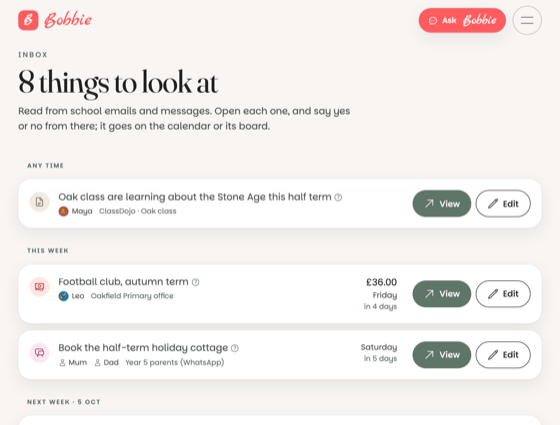
- It reads all of them. A long newsletter can produce a dozen items; each waits in the Inbox on its own so you can keep the ones that matter and bin the rest with a tap each.
- Why did it skip something?
- It keeps things that have a date, a cost, an action or a thing to bring. General news ('Year 4 enjoyed their trip') is deliberately left out. If it missed something with a date, open the original in the Inbox and add it by hand, and tell us.