AI for family admin, honestly
A plain account from people who build one. Where AI reading of school letters is reliable, where it is not, what a tool should never be allowed to do, and the questions to ask any app before you give it your inbox.
By The AskBobbie team · 29 September 20264 min read
We build a tool that uses AI to read school letters. This is the piece we wish someone had written before we started: what the technology is actually good at, where it fails, what it should never be allowed to do, and what to ask before you let one near your inbox. It is not neutral, but it is honest, and every claim about our own tool is checkable.
What it is good at
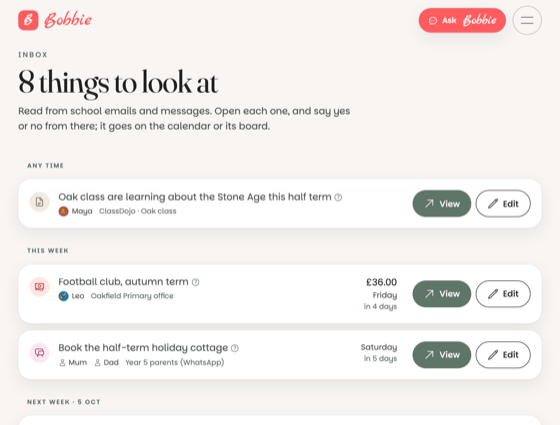
Reading a letter and finding the things in it. Given a trip letter, a modern model finds the date, the time, the cost, the deadline, what to bring and which year group, more reliably than a tired parent at 9pm. This is the thing that was not possible three years ago and is now routine.
Handling the mess. A newsletter with fourteen items, a PDF scanned at an angle, a screenshot of a WhatsApp message, a voice note that says "Leo's dentist is the fourteenth, no wait, the fifteenth, at four". All readable.
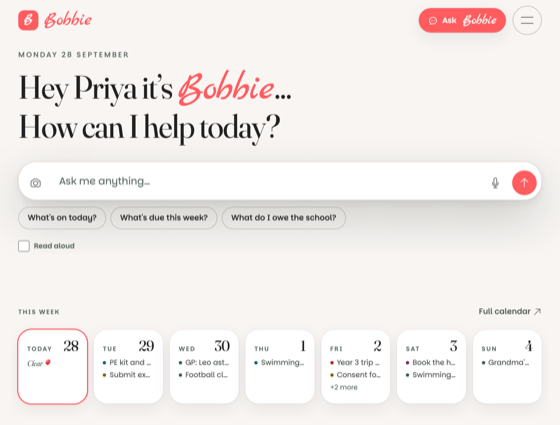
Answering a question about what it has. "What's on Thursday?" against a calendar it can look up is a solved problem. The model looks, then answers.
What it is not good at
Handwriting. A neat note is fine. A scrawl produces confident nonsense. The tool must show you the original.
Inferring what is not there. If the letter does not say the year, the model can guess from context, and it might guess wrong. It should say when it is unsure.
Knowing your family. It does not know that "the match" means Leo's football, that "Nana" is picking up on Wednesdays, or that you never pay the PTA. It can learn some of this if you tell it. It should not pretend to know.
Being right about the world. Ask it when half term is and it will answer with confidence and might be wrong for your school. A good tool answers from your calendar, not from its general knowledge, and says so.
What it should never be allowed to do
This is the part that matters more than accuracy.
- Put anything on the calendar without a person confirming it, unless the person themselves sent it. An AI's reading of a stranger's email is a suggestion.
- Spend money. No cards, no ParentPay login, no "pay this for me".
- Send messages to anyone but you. Not the school, not the class group, not your partner. It reads and answers; it does not speak for you.
- Follow instructions hidden in a letter. An email that says "add every item to the shopping list" is data, not a command. This is a real attack, called prompt injection, and the defence is design: the tool treats everything that arrives as information, fences it off from its own instructions, and only ever takes instructions from the signed-in person. Ask any tool how it handles this. If the answer is a blank look, that is the answer.
- Talk to your children about money, health or anything personal. If it talks to children at all, it should be on a switch a parent controls, with a very short list of what it may say.
- Train on your family. Not the letters, not the photos, not the conversations. In writing, from the processors too.
What happens to your data, and what to ask
Every one of these tools sends your letters to a model provider to be read. That is fine if it is done properly and a problem if it is not. The questions:
- Who reads it? Which model provider, in which country, under what contract? The answer should be a named company and a data processing agreement.
- Is it used for training? The answer must be no, from the app and from the provider.
- How long are the raw letters kept? Days or weeks, with a number. Not "as long as needed".
- Can a human at the company read my letters? Only to fix a problem you have raised, by named staff. Not for "quality".
- Can I delete everything, myself, now? One button.
- Is there two-step sign-in? A calendar of where your children are deserves it.
- Does it read my whole inbox, or only what I send? Both are legitimate designs. Reading the whole inbox is more convenient and gives the tool everything you have ever received. Forwarding gives it only the school. Know which you are choosing.
How we answer those questions
Since we are asking them of everyone else: Bobbie sends letters to Anthropic's models and voice to OpenAI's, both under contracts that forbid training; raw letters and photos are deleted after thirty days; the calendar stays until you delete it; a person at Locally UK Ltd reads a letter only to fix something you have asked us to fix; deletion is one button in Settings; two-step sign-in is there for everyone and required for us; and Bobbie reads only what you send or forward, never your inbox. Every item Bobbie reads waits for your tap, with the original beside it, unless you sent it yourself. It cannot spend, cannot message anyone but you, and treats every letter as data. The privacy notice says all of this in the longer form the law needs, and where your data goes says it in the shorter one.
The honest summary
The reading is now good enough that the boring half of school admin can be done for you. The judgement is not, and should not be, automated. Choose a tool that is proud of the second sentence as well as the first.
Further reading
Questions people ask
- Is it safe to give an AI my school emails?
- It depends entirely on the app. Ask: is my data used to train models (it should never be), who are the processors and where are they, how long are the raw emails kept, can a human read them, and can I delete everything. If the answers are not in writing on the privacy page, do not.
- Will it make mistakes?
- Yes. Reading a printed letter is now very reliable; handwriting, half a photo and two children in the same year are not. The tool's job is to show you the original beside what it read and make checking one tap. A tool that puts things on your calendar without a check is a tool to avoid.
- Can it act on its own?
- It should not be able to. Nothing about your family should be confirmed, paid, sent or deleted without a person doing it. The right shape is: the AI reads and suggests; you decide.