The school admin problem, and what to do about it
UK parents get 40 to 70 school messages a week in term time, across five systems and a book bag. Where it all comes from, why it lands on one person, and a plan that takes an hour to set up and holds all year.
By The AskBobbie team · 29 September 20265 min read
It is Tuesday. There is a ParentMail about a trip, an Arbor notification about a club, a ClassDojo story with a date buried in the fourth paragraph, a WhatsApp from another parent asking if anyone knows about the thing on Thursday, and a crumpled letter at the bottom of a book bag about harvest. None of them is difficult. Together they are a second job, and in most households it is one person's.
This is a long piece about why that is, and what a family can do about it in an hour. We make a tool for it, and we say where it fits; most of what follows works with a paper diary.
How much there is
Sense, who make a family app, tested with UK families across a school year and counted 40 to 70 school communications a week in term time. That matches what we hear. A primary school with an active PTA and a couple of clubs runs to two or three messages a day, and a family with two children at different schools doubles it.
It is not that any one message is hard. It is that they arrive in five places, in five formats, and each expects you to do something: pay, sign, remember, bring, reply. And they do not arrive when you are sitting at a desk with a calendar open. They arrive at 3:32pm in a car park.
Where it comes from
| Channel | What arrives there | Why it is hard |
|---|---|---|
| Email from the office | Letters, newsletters, trip forms | Long, many things in one, easy to skim past the date |
| ParentPay, SchoolMoney, Arbor Pay | Payment requests, dinner money, receipts | Payment and letter are separate; the deadline is in the app, the reason in the email |
| Arbor, MCAS, School Gateway, Weduc | Absence, clubs, consent, bookings | Notifications that vanish; each school's system is different |
| ClassDojo, Tapestry, Seesaw | Class stories, teacher messages | The date is in a photo caption; nothing is searchable |
| The class WhatsApp group | Reminders, rumours, lost jumpers | The one message that matters is buried in forty that do not |
| The book bag | Paper letters, permission slips, art | Found on Sunday night, due on Monday |
Every one of these was set up by a different part of the school, or by a supplier, to solve that part's problem. None of them talks to the others. The parent is the integration layer.
Why it lands on one person
Three defaults, none chosen:
- The systems want one contact. ParentPay, Arbor and the rest are built around a primary parent. A second one is possible in some and not others, and it takes asking.
- The class group has one of you. Someone joined in Reception. That person is now the family's ear.
- Whoever answered first is the one the school writes to. Offices write back to the address that replied. Two years later that is the address for everything.
The result is that one adult holds the picture and the other asks "what's on this week?", which is not a fair question to ask or to answer. The government's own parent surveys find awareness of what the school offers falling year on year; more messages have not produced more knowledge.
The plan: an hour, once
The aim is one place where everything lands and every grown-up can see it. Whether that place is a shared paper calendar in the kitchen, a shared Google Calendar, or a tool that reads letters for you, the steps are the same.
1. Pick the place
Somewhere every grown-up looks daily without effort. If one of you lives in Google Calendar and the other does not open it, that is not the place. A kitchen wall calendar counts if you both walk past it. A tool that puts a card in front of both of you counts. A person's memory does not.
2. Point every channel at it
- Email: forward the school's emails to one address, whether that is a shared family address, a folder, or a tool that reads them. One forwarding rule, five minutes, and it never needs doing again. See forwarding from Gmail.
- Payment systems: add the same address as a second contact in ParentPay and the rest, so the receipts and requests land in the same place as the letters. See where the box is in each system.
- The class group: mute it, and agree that whoever sees something that matters puts it in the place. See the survival guide.
- The book bag: photograph the letter the moment it comes out, and send the photo to the place. Thirty seconds beats Sunday night.
3. Split the confirming, not the reading
The reading is the part that eats the time. If a tool does it, the remaining job is a tap per item, and that can be anyone's. If a person does it, take turns by week rather than by channel, so that neither of you becomes the only one who knows how ParentPay works.
4. Ask, don't remember
Once everything is in one place, the question "what's on Thursday?" has an answer that is not in anyone's head. Ask the place. If the place can be asked in words (Bobbie can, on WhatsApp or in the app), the person who is out can ask from the car park.
What we built, and where it fits
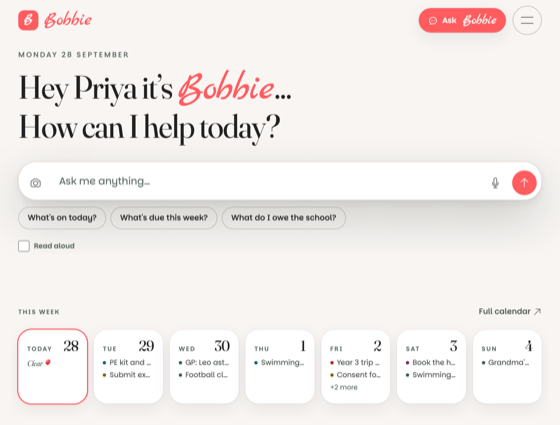
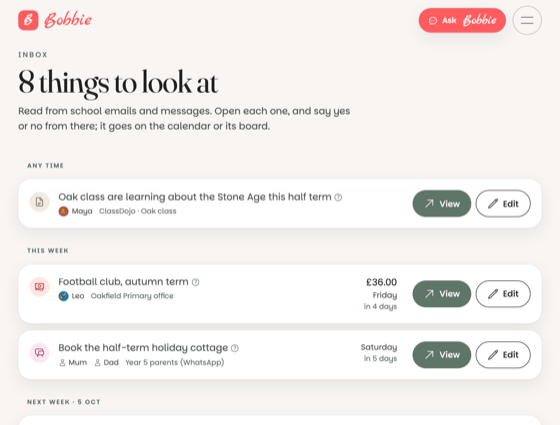
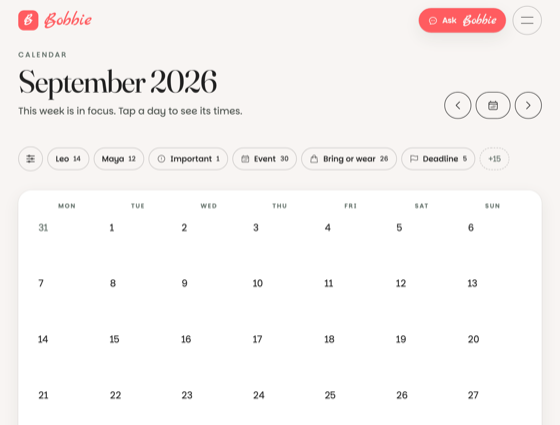
AskBobbie is the "place" in the plan above, with the reading done for you. You give the school one email address or forward what you get; Bobbie reads each letter into the dates, the money, what to bring and what to sign, files each under the right child, and every grown-up sees the same calendar. You confirm each thing with a tap, and ask it what's on. It is the tool we wanted for our own families, and the plan above is how we use it.
But the plan is the point. A family that does steps 1 to 4 with a wall calendar and a forwarding rule has solved most of the problem. The tool takes the reading off you; the deciding was always yours.
Further reading
- Every UK school system explained for parents
- The class WhatsApp group: a survival guide
- Term dates, INSET days and the dates schools spring on you
- School money without the surprises
Sources: Sense, "Best family organiser apps UK 2026" for the count of messages; GOV.UK parent, pupil and learner voice surveys.
Questions people ask
- Is it really 50 messages a week?
- Between 40 and 70 in term time for a typical family, according to Sense's 2026 testing with UK families, across ParentMail, Arbor, ClassDojo, email, WhatsApp and paper. Two children at different schools can double it.
- Why does it always end up with one parent?
- Because the systems ask for one contact, the class group has one parent from each family, and whoever answered the first email becomes the person the school writes to. It is a default nobody chose, and it can be changed by giving every grown-up the same view.
- What is the single most useful change?
- One place everything lands, that every grown-up can see. Whether that is a shared calendar you type into or a tool that reads the letters for you, the point is that the knowledge stops living in one person's head.